

On Reading With Children
Thoughts From An Avowed Children's Book Fan

[A Heads Up to new Readers: There is an audio version of this post that highlights some of the principles discussed. The audio is usually reserved for subscribers, but this is an opportunity to try it out! ]
There are so many things that can be said about reading with children, a subject that is near and dear to my heart. There are whole articles and substacks and websites and books on the topic, so if you’re really interested in all the ins and outs, you can peruse to your heart’s content. No need to go into all of that here, though I would highly recommend this recent Substack post! So I thought maybe I’d focus on a few key points that always feel most salient to me, as a lifelong lover of reading, reading to children, reading with children, and children. Let this be a start, just a few neat and quick things to take in, mull over, and maybe start to implement. Okay? Okay.
So here goes, my top five suggestions [aka pet peeves] about reading with children:
1. All reading to children is reading with children.
Read that again. Maybe read it out loud, just to make sure it got in. And, you know, to practice reading things out loud, because that’s what we’re talking about. Practice where the emphasis goes in the sentence, because that’s important in reading out loud. It’s practice. Clever, eh?
All reading to children is reading with children.
Did you read it out loud?
Good job.
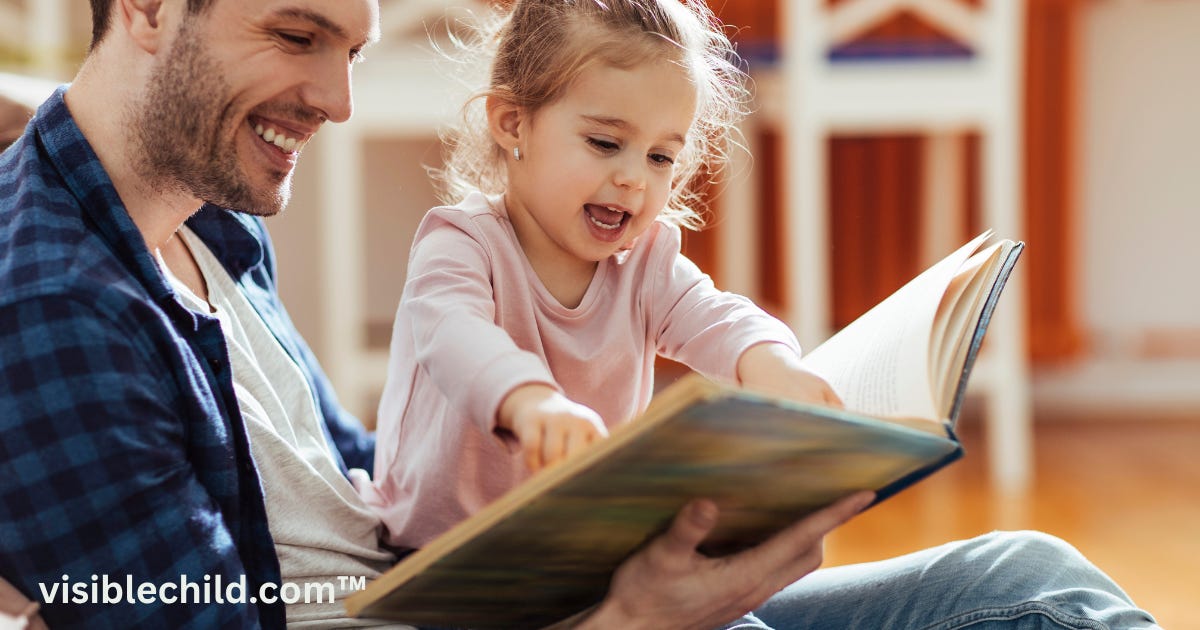
“To” and “With” are pretty important concepts across the board. In our culture, the norm is so often to “do to” not to “do with.'“ I’d like to advocate for a shift to the latter. Our relationships with children, even our limit setting with children, are often “tos” not “withs,” even when we consider ourselves “enlightened” and mean to do otherwise. Children are people, who can participate as full partners in our interactions from birth. We don’t have to do things to them; we can do all things with them. When we do that from birth, we establish and strengthen a reciprocal, respectful relationship, rather than a hierarchical, didactic one. In case you’re new to Visible Child, that reciprocal respect is what we’re after. So start early. And reading is one example. It’s a joint activity, not something we are delivering to the child.
You’re probably asking the obvious question: What’s the difference? What does it look like to “read to” and “read with?” Well, my friends, it really comes down to control. If you’re reading to them, you are imparting. If you are reading with them, you are sharing. When you are imparting, the child is a passive recipient, the vessel into which you are pouring the information or the words or the content of a book. When you are sharing, the child is an active participant, constantly invited to engage with the words and content with curiosity, joy, emotion, and even distraction.
To get super concrete—for those who love such things—reading with children means largely abandoning your adult goals and perspective, warmly inviting reactions and questions without regarding them as interruptions, and welcoming the child’s perspective on what is being read at all times.
With that in mind….
2. You don’t have to finish books or chapters.
I know.
Mind-blowing.
A book or a chapter isn’t something to “get through.” It genuinely doesn’t make any difference if you finish a book or a chapter. You can always come back to it another time or another day. Or maybe you won’t. Maybe one or both of you will move on, and there will be no interest in continuing. Or maybe your child will ask to come back to that book and just turn to one or two pages that they found particularly fascinating or hilarious and just read those two and giggle. That’s okay too. It’s all okay.
I know that, as adults, we do like to finish books or chapters. It makes sense to us. It’s just a grown-up thing to do. Here is the beginning. Here is the middle. Here is the end. Here is the temporary stopping point that has been officially approved for stopping so we can pick up the book another day and start at that point. In the language of literacy development, it’s a “book convention”, like learning that we read from left to right and top to bottom (in the West, that is), like the blurb and the front and back cover. But this particular book convention, that you must start at the beginning and read to the end, is a peculiarly adult frame. For young children—children under 7 or so—it really makes very little sense much of the time, and there’s no reason that we should cling to that convention in the interest of “teaching”, or, worse yet, for our own comfort. Older children, children who are reading chapter books, or with whom we are reading chapter books, may very well have already adopted those “rules” and demand that the book or chapter end where it ends, and not a second before. That’s okay. If the child is the one initiating that request, then you’re still reading “with.”
Try it. Pay attention. Listen to yourself. Your child keeps interrupting and asking questions about the book or wanting to go backwards to an earlier page or wanting to talk about something that happened at school that day. When you find yourself saying (even very sweetly) “Let’s get back to the book now” or “Let’s just finish up this book” or even “What do you think is going to happen next?” (which is sometimes a great question), when it is used as an overt (manipulative?) tactic to get them to reengage with the book when they have drifted off to another topic. Maybe the reading of this book is over for the night. No need for frustration like “we never finish a book!!” It’s okay to not finish a book. This is about nurturing a love of reading and an important source of loving connection—an opportunity for children to come to associate reading with love and closeness and laughter. It doesn’t matter what else happens.
3. Reading aloud should be a joy, not a chore.
This is where I go out on a limb and remind you that it does children no favors for parents to engage in activities that they dread or resent.
For example, a lot of you read aloud to children at bedtime, as I did with my daughter. That can be a wonderful, relaxing, connecting way to end the day, and a beautiful ritual that can go on for years, including beyond the age at which they can read to themselves. It is also the time of day when both parents and children are tired and sometimes short on resources. As a result, it’s not uncommon for books and reading together to become a threat or a bargaining chip of sorts when parents are frustrated at children’s bedtime-delaying tactics. If this is you, I would strongly encourage you to make reading together a part of your lives at another time of day, when you’re better able to manage your own emotions around delays, limit testing, and the other challenges that sometimes come with bedtime. But why, you ask? Why not push through and read with children when that’s such a nice thing to do at bedtime—or something that you’re “supposed” to do? Well, I’ll tell you. Because, first of all, children are omniscient. They always know when you’re not happy about a task. They always know. And over time, that creates associations with books and reading that are filled with dread and resentment. And that, in turn, does no favors for your connection.
So, are you a failure or a terrible parent if you resent reading at bedtime? No. You’re not. Just find another time. Or if you really dislike reading aloud at any time, then find other ways to connect and let another parent, a babysitter, a librarian, a teacher, a local teenager, or a relative read with your child when the opportunity presents itself. It’s okay. It doesn’t have to be your thing. But if you want to make it your thing—if you want it to be your thing—then it’s important to do the work to be able to transmit the joy of books and reading together, most of which is nonverbal. Try reading some really goofy books that will make you and your child laugh together. That sometimes is the magical ingredient that can help you relax into the task. And (see #1 & #2 above), it’s okay if you only get through a couple of pages. It’s the connection and the joy that matter.
4. Get Over Yourself
Reading with children is a time to leave behind your grown up self and revel in the fantasy. It’s your time to be a child, or at least to remember what it was like to be a child, which is kind of the same thing.
This is, unfortunately, a problem for a lot of people, or so I have consistently found. Here’s the thing. A lot of us, for some reason, have some sort of attachment to being “mature adults” who presumably no longer play or act goofy or make fools of ourselves. I know. I don’t get it either. But then again, I’m still five. I also lean toward the attitude that children, with all their goofiness, are much more interesting and fun than adults. So there’s that.
Playfulness is a good thing. I promise. You can nurture it. You can welcome it. You can practice it. If you need inspiration, check out Mia Wisinski at Playful Heart Parenting. So. Many. Great. Ideas. And such joy. Check it out.
So, this is the challenge laid in front of you here. If you read aloud like a “grown-up”, it’s likely to be, well, boring. Books are not made to be read as simple words on a page. Dialogue is not meant to be simply “this is what they said.” They may be words—or if you’re a young child, random squiggles—on a page, but we are supposed to “hear” the intonation, the tone, the emotion, the intention, the essence of the character. When you’re reading out loud, you’re supposed to embody all of those things….out loud. This is what makes the story come to life. It’s what engages children; it’s what makes reading with children absolutely wonderful. Nobody’s watching you. Go ahead.
Yes, I know there is a cheating version. You can play audiobooks, where other people (people more talented at this than you, you would say) do the voices and the intonations. You can show your children Disney Pooh movies (which are sweet but in no way as good as the books, as is almost always true), because after all, they do tell some of the same stories. And then, of course, you can’t read the wonderful books anymore because your children will have an idea of what Pooh and Piglet and Tigger sound like, and that will be the “right” sound, and then you won’t be able to duplicate that because they will be disappointed or critical, so you may as well not do it. (Always looking for an out, such an adult thing). Or you could skip all of that and make your voice the first one they think of, so that they screw up their little faces in confusion and disappointment when they do eventually watch the movies or listen to the stories. I beg of you, don’t take the shortcut. Read them. Be the characters. Carry the tone and emotion of the words. For what it’s worth, you don’t have to “do” the voices as if you are a professional voiceover artist. Your own voice is fine. Just slight variations, with intonation, is plenty.
Embody the wonder of a child.


Three examples come to mind, from three books that I love or that my daughter and I really enjoyed reading together when she was young: The Gruffalo, Winnie-the-Pooh, and the Moomintroll books. By the way, the Moomin books are one of my top two favorite pieces of children’s literature in the entire world, the other being Rootabaga Stories by Carl Sandburg, just in case you’re wondering. I’d like to share each of these as an illustration. I’ve made a video of me discussing this a bit more, and reading from each of these books, as a demonstration. That video will be posted as a stand-alone post tomorrow, so please check back, and be sure to subscribe!
! Here’s a short preview, there’s much more!
5. Read What You Love. And What They Love.
Not to be Captain Obvious, but not all books are the same. That’s not to suggest that you should be a children’s book snob (even though I do self-define as such at times!) and only read a particular kind of book to your child. Yes, there are books that have wonderful rhyme schemes, books that are lulling, books that just name things, books you loved as a child. There are books that clearly aim to transmit particular values, some of which you may want to impart, others you may prefer to avoid. There are books that are essentially marketing for movies, toys, TV shows, or video games. There are even books that seem to “prime” young children for “action films” and action “characters” at older ages, something that could be considered marketing as well. In my view—and it’s just my view—the worst kind of books are the ones that are trying to “teach” the child something. Sure, there are terrific ABC books. Read them if you want…but without expectations or the quizzing.
Read what you love. And then follow the child. Are they interested? Do they love it like you do? No? It’s okay to move on. You don’t have to convince them. Maybe you’ll try again at an older age. Maybe it will appeal to them then. Maybe not. They’re people, and we all have different tastes.
Above, I mentioned The Rootabaga Stories, by Carl Sandburg. If you are familiar with them, you know they are an odd, offbeat, poetic, nonsensical collection of fantastical stories (which kind of explains why I like them; I’m quite like those things myself!). Every time I read the first chapter of the Rootabaga Stories, “How They Broke Away To Go To The Rootabaga Country” (my favorite chapter, which is lucky given the number of times I’ve read it!), my daughter fell asleep while I was reading. Every. Single. Time. We never finished the chapter. It made me second-guess the choice. I love this book. She doesn’t. Oh, that makes me so sad. Can’t she even just love the first chapter? Can’t she even see the immense beauty in the description of a “long slick yellow leather slab ticket with a blue spanch across it” Really?!? I still read it from time to time. And I reframed—for myself. I came to realize that one of the most beautiful things about the book is that the text is melodic, lyrical, like poetry that doesn’t quite make sense sometimes. It doesn’t “rev you up” or make you laugh or provoke questions (unless it’s “what is his name??”). It hypnotizes. So it makes perfect sense that it lends itself to sleep. For what it’s worth, in recent years, I read it to my partner, and the same thing happened. I guess that’s the kind of book it is. I still love it.
And then there’s what I consider the other end of the spectrum, which has two primary variations: repetition and a genre that I refer to as “Barbie books” (whether they are about Barbie or not). Maybe it would be simpler to say “books or reading that make you groan” - that pretty much covers it. And, just as in the first example, these present a similar opportunity to reframe. (Come to think of it, there’s not really a time that isn’t an opportunity to reframe; it’s such a valuable lens adjustment tool!). We undoubtedly all have different things that “make us groan”, but these two seem to be some of the most frequent. First, repetition. Books that children—especially toddlers—want to read again and again and again, sometimes to the exclusion of other books. Just that book. Every night. Every day. You’re tired of reading it. You want to “broaden their horizons.” Your perspective is surely fair. As is theirs. And reading a book over and over is not only developmentally typical, it’s also quite valuable. Now, of course, you might love the ritual of reading “Goodnight Moon” every night for months or years. More power to you; that’s wonderful. For someone else, they may feel like they are losing their mind. You are allowed to have boundaries for your own sanity—just don’t pretend that you’re doing it for the child. Stay honest about it.
The second, the “Barbie books” (my term, derisive as it may be—yeah, my bias is showing, and I’m not only talking about Barbie) are the books that can sometimes feel like they have no “chops” as books—certainly as “literature”, which is a label that does actually apply to children’s books—but mostly can be seen a marketing tool or a way of cementing stereotypical gender norms. (Yes, I know the pro and anti-Barbie arguments; that’s for another post.) For me, it was something like “All these lovely picture books or early readers and you want the Barbie books?” The answer here? Get the books. Read the books. As many times as they want. The same goes for “truck books,” which wind up being a recitation of all the possible kinds of trucks and machinery. If this is what they love—however they got there—then read them with your children. And remember libraries—those magical, wonderful places that are now wildly underused. You don’t have to buy all these books. They’re all there, in the library. Speaking of libraries, take your kids. You don’t need to take them at a planned time, to a story time or an activity. Just go. Let them wander around and choose books at random. Sometimes amazing books are found by children, you might even find something that you love, as I did many times over
When it comes to children, there are no bad books. Non-fiction is great. Facts are wonderful. Barbie books? Sure. The books you love? Definitely. As ever, follow the child. And in case you forgot, reading together is not about the content. It’s about nurturing the love of the written word and imagination, all encoded wordlessly in the warmth, engagement, laughter, and closeness of a parent or teacher.
I still have on my shelf some of the books that my family read with me. They are a bit battered—as well-loved toys and books should be—but they remain dear. I also have on my shelf some of the books that I read with my daughter. I don’t even have to take them out and look at them; all I have to do is see the spines, and I can call into memory the laughter and closeness and how much we enjoyed that time together.
When do you read with your children? Do you use intonation and voice the characters? Have you learned to let go and follow the child, even if it means not finishing or embracing interruption? Have you used reading time as a threat to induce compliance at bedtime? What memories will your children preserve on their bookshelves as adults?
I adored Homer Price when I was 5ish and have been trying to read my daughter (almost 6) the stories at bedtime. She LOVES the story about the robbers and the skunk and has zero interest in the others. She loves the Dance at Grandpa's chapter in Little House and has minimal interest in the others. She likes the Everything Pudding chapter in Betsy Tacy and has minimal interest in the others. It's very confusing for me and I have been worrying if I am doing something wrong!? Reading that back now it sounds kind of ridiculous. Also... these stories all share an element of merry chaos that is so exactly like her personality... This was great, reassuring, made me smile. Thank you.
Thank you for point number 2! It’s ok to not finish books or to go back to old pages - this is really helpful to hear!