

Sharp Stones in the River
The Perils of "Going Upstream"

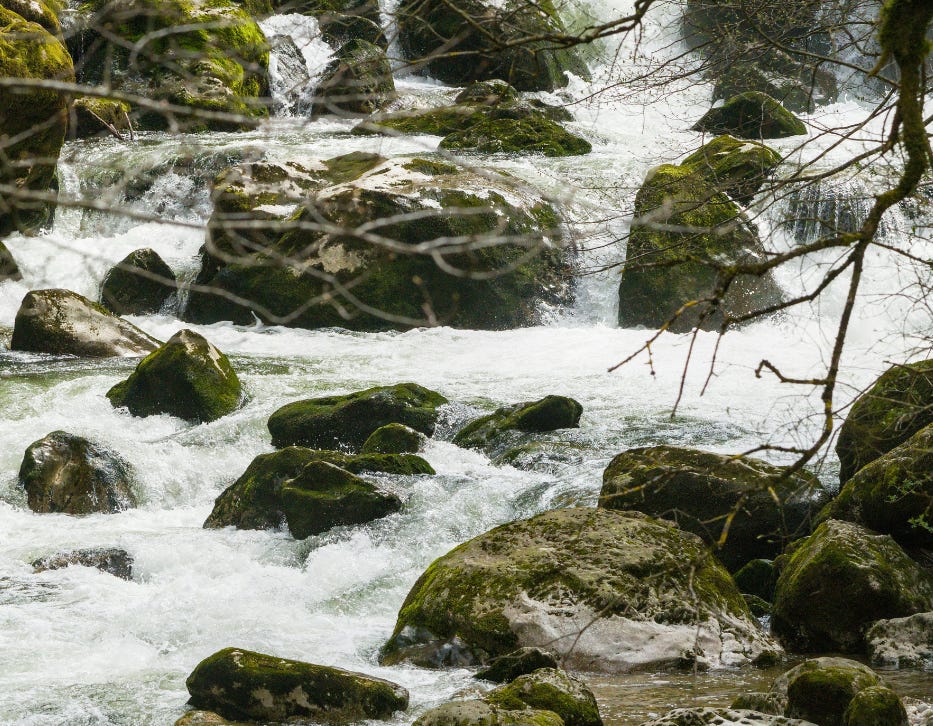
In Visible Child, we talk a lot about “going upstream” when children have difficulties or challenging behavior. In its simplest form, “going upstream” refers to the idea that all behavior is communication, that all behavior is expression of a need. This sort of idea stands in contrast to the idea of behavior as something to be “corrected” or changed. Of course, we do often want troubling behavior to stop…but rather than spending our time and energy figuring out what strategies to use to “get them to stop”, we choose to focus on what need or message they are trying to communicate. With that information, we can address those needs, and in turn, the behavior will end, because it is no longer needed. We call that seeking for the underlying message “going upstream.
People sometimes struggle with the expression, get lost about what “going upstream” means, or wonder why we use that particular jargon. So with that in mind, let me offer both a literal and metaphorical explanation.
The most visceral, not to mention literal, explanation usually helps—namely, that of your hypothetical house or business on a river that is becoming increasingly polluted. You’re regularly finding dead fish, the once pristine, clear river now looks brown and murky, and there is a smelly scum on the surface. Ick.
That’s the problem that’s right in front of you—or in front of your house. In the context of Visible Child, it’s akin to “my four-year-old is hitting me” or “my three-year-old has hour-long tantrums” or “our seven-year-old refuses to participate in any extracurricular activities.” Those are the problems that are right in front of you. They’re the river.
The most common response to problems with kids, and the most common questions I receive are about how to get them to stop hitting or how to shorten or end the tantrums or how to get them to join sports or afterschool activities— or what to do when they do hit or tantrum or refuse.
Which brings us back to the river. Remember the river?
You can go down to the river every day with your skimmer and skim the scum (ooh, that’s a melodic phrase) off the top, and scoop out the dead fish, or complain to the powers-that-be that your river is dirty. And the next day, it will still be that way. And the day after. And the day after.
It will be like that until you go upstream and find out where the pollution is entering the river, where it comes from, and take action, perhaps with the support of others, to address that polluting source. If you want the river to be clean again, the only real way to do that is to find out what’s going on upstream.
The same is true of children. Until you “clean up” and address the real problem, the problem in front of you is going to remain. Of course, with kids it’s a little different because it may look like you solved the problem for a short time. Maybe you get angry or you “get serious about discipline” and now they’re not hitting anymore. And then a couple months later, there’s another problem, that sometimes seems to have come out of nowhere. It seems unrelated—but it very well may not be.
If the upstream issue is not addressed, if the need they are trying to communicate is not met in some form, they are going to continue to try to get you to “hear” it in one way or another. Children are clever—and persistent—like that. A need is a need, and they’re going to keep telling us. What we’re after, in respectful parenting, is to make the problematic behaviors unnecessary, because the need they are trying to express no longer exists.
Does that mean it’s easy? We figure out what’s causing it, we “go upstream”—or we think we do—and we change that thing, but then they’re still hitting! This going upstream thing is for the birds!
Yeah. Well, sometimes we’re wrong. Sometimes we’re not great observers or we have a hard time slowing down enough to notice and watch what might be happening. Sometimes we’re impatient. We think that behavior will disappear right away (even though we know a river doesn’t get magically clean in a day or a week, even when the polluters stop their dumping.). Sometimes we miss the part where we’ve inadvertently been a part of the problem, by having big or angry or dysregulated responses, which make it much harder for children to regulate their own emotions. Maybe we’re contributing to the pollution, even if in our small downstream ways. Sometimes, we’re so focused on solving problems that we aren’t the best at listening deeply and reflectively to children, one of the very best ways to find out what actually lies upstream, especially for kids over four or so. Sometimes we forget to examine our tendencies to exert arbitrary control, something that never works well with children and is bound to create a need for resistance. Sometimes, we just get in our own way.
Earlier today, I was browsing the comments section of a piece that a colleague wrote about how to respond to children’s aggression. In doing so, I encountered an all-too-familiar refrain. A parent was asking what to do when a child was melting down over “nothing.” I wanted to read more with an open mind, so I set aside for a moment the importance of acknowledging that little things to us might be big things for children—a critical feature of respect. I also set aside the fact that when children “melt down”, it’s rarely about the simple situation in front of you—the uber-obvious “trigger,” but more likely about the need for emotional and stress release, brought on by a whole panoply of variables. I read on. And here’s what I read.
”Last night my child wanted more ketchup – I said they had had enough…so they got up and hit me.”
It’s tempting to think this was about the request/demand for ketchup, possibly reinforced by the “so” in the middle, as if this is simple cause and effect. I’m quite confident that it’s not about the ketchup. Of course, I don’t know all the things that it might be about, because I’m not there, observing that child’s life on a day-to-day and hour-by-hour basis.
(By the way, that’s a persistent fantasy of mine, to be able to magically and invisibly fly to people’s homes, wherever they may be in the world, and observe for a day or so. I’m confident that the patterns and variables at work would be abundantly clear, and man, that would sure make my support work so much easier. To be clear, I don’t have any sort of magic (other than being a really good observer, which is a bit magical in itself). It’s just that my coaching work depends on parents’ observations and reports, and as we all know, when something is ever-present, you stop detecting it—the now invisible pile of out-of-season shoes piled in the entry way of my house can testify—so an outsider’s vantage point can be invaluable. Anyone out there that wants to create a respectful parenting spinoff of Supernanny, gimme a call, I’m your gal!)
What I do know, aside from all other stresses in that child’s life, is that young children have precious little agency. And we have precious little empathy for their precious little agency. So that’s the starting point.
This one fits sqarely, then, into the above-mentioned categories of “sometimes we forget to examine our tendencies to exert arbitrary control” and “Sometimes, we just get in our own way.” Is controlling whether a child has one tablespoon or two or three tablespoons of ketchup really worth it? (Yes, we could have a discussion about the questionable nutrition of ketchup, but if you’re that concerned, then maybe stop buying it altogether?) Are you aware that nutrionists remind us that creating a scarcity mindset by restricting certain foods, including condiments, can contribute to disordered eating? Why can’t they have more ketchup or decide how much they want to have?? How often are arbitrary limits at the core of our children’s difficulties? Would YOU want someone measuring out exactly what you could have or not have? Would YOU want to be at the mercy of other people deciding what’s okay or not okay, all day long, every day? Do you like feeling controlled? Is it possible that that sort of control could predict significant protest?
And while we’re at it, let’s also take a look for a moment at that “You’ve had enough.” How would you respond or feel if a fellow adult reached over to your plate and said “You’ve had enough?” I suspect that you’d prefer the respect and autonomy of deciding for yourself what is “enough,” because you are the only one in your body and you are the only one who knows how your body feels and what it needs or wants. Would you say that to another adult? What have you heard from people who are trying to lose weight about people telling them “you’ve had enough?” Have you ever heard of someone saying “Oh, you’re right, thanks so much for letting me know” and feeling just all around happy and peaceful with other people regulating (shaming?) them around their eating? Children want and deserve the same. Is it possible that the hitting was not only about the ketchup or about food restriction, but also about feeling insulted or shamed by people who feel they know when you have “had enough?” At the very least, it’s worth thinking about.
So you see, there isn’t any “I didn’t give them more ketchup, so they hit me.” It’s closer to “They are tired of having people correct and limit and decide things for them all day every day, and this just happened to be one of the times when the straw broke the camel’s back. And the “you’ve had enough” didn’t ‘help.”
So, you’re saying that I should just give kids whatever they want so they won’t hit? That sounds a lot like walking on eggshells or permissive parenting, and I didn’t think that was what Visible Child was about. I thought you supported appropriate limits and boundaries!
No. I’m not saying you should just give kids whatever they want so they won’t hit. I am saying that arbitrary rules or corrections play a role in the behavior that is causing you concern.
No. I’m not advocating for walking on eggshells or permissive parenting. No, those aren’t what Visible Child is about. You are the grown-ups. You still decide how things work in your household. Your child is not “running the show.” And you are taking that role and responsibility seriously, so that you’re keeping tabs on whether you might just be a little high on control.
Yes. I do support appropriate limits and boundaries. Defensible ones. Well thought through ones. Conscious ones. Sensitive ones. All in the context of observation, which allows you to notice whether your child is feeling overly controlled. All in the spirit of mindfulness, in which you “practice the pause” to evaluate whether this is really a limit or a boundary that needs to be held.
When a child explodes or sobs in the afternoon after school, are you deciding what it’s about, based on your own hunches? Or are you asking them, giving them space to decide whether or not they want to talk about it? Are you deciding that it’s “restraint collapse” from the pressures and expectations of school, from holding emotions in all day in order to be a “good student”? What if it’s the residue of something that happened last night or this morning? What if their best friend wasn’t at school today? What if they are disappointed with themselves about a particular task or assignment? What if they’ve had enough of school for the day and can’t bring themselves to tell you that they’re also supposed to do homework and they really can’t take any more? What if someone looked at them wrong? What if they want to be babied (regardless of age), sit on your lap, rock, and just cry, because we all have days like that sometimes? What if you just told them that someone is coming over this evening for dinner, and they had been looking forward to a whole evening of “downtime”?
I could go on. The list is endless. You have to walk upstream—slowly, persistently, willing to step on sharp rocks or stumble—to find out. And maybe you won’t figure out what happened today. That’s okay. This is a practice, much like a walking meditation. Keep walking. Keep practicing careful steps.
Curiosity is your friend. Assumptions are your downfall. Control is your enemy.
It takes time to go upstream. There’s not always a smooth road or an idyllic path along the stream. Sometimes we have to hike up our pants and walk into the river, among the sharp stones. Sometimes a stone shifts and we fall or get bruised or cut feet or we slip and get soaked. It’s not always pleasant or fast. But even then, we have to keep going upstream, because if we don’t, we’ll never solve the problem. Remember, when the problem is solved, the behavior will no longer be necessary, because the need will be met.
And yes, I know. The question still remains. But what do I do when it happens?
Survive. Do your best. Stay calm. Validate. Listen. Don’t take it personally. Drop the rope. Offer safety. Remember compassion. Block aggression if need be, without anger or distress. Yes, a lot of this is our own inner work. Our own regulation is tough, and it’s 90% of success or failure—if you’re emotions aren’t in check, you literally cannot effectively help a child to regulate.
And then go upstream.
Wanting more about what it looks and sounds like to respond in the heat of the moment and “go upstream”? Check out the premium video below!
